
Synthetic Identity Fraud and AI: Updating Detection Controls for Evolving Attack Patterns
Synthetic identity fraud occurs when genuine personal information is combined with fabricated details to create an identity used to obtain financial products, services, or other benefits. Generative AI can make fabricated documents, images, and personas more convincing, while automation enables fraudsters to submit applications and test onboarding controls at scale.
The risk extends beyond account opening. A synthetic identity may accumulate account history over months or years before a criminal exploits credit lines, abandons balances, or uses the account in other fraudulent activity. Detection strategies that rely on isolated identity checks may miss these patterns, particularly when genuine identifiers belong to real individuals.
Financial institutions need a layered approach that connects identity verification, application analysis, linked-identity signals, and ongoing account monitoring. AI-enabled tools can help identify anomalies and relationships, but a suspicious signal is not proof of fraud. Effective controls combine technology with clear review procedures, documented decisions, appropriate escalation, and continuous improvement.
This article examines how synthetic identity fraud evolves, where institutions are exposed, and how financial services organizations can strengthen AI-enabled detection while maintaining fair, risk-based decisions.
Table of Contents
Section 1: Understanding Synthetic Identity Fraud and Evolving Attack Patterns
How Synthetic Identities Are Constructed
Fraudsters combine genuine identifiers, such as a real Social Security number, address, or other personal information, with fabricated names, birth dates, employment details, contact information, and account histories. The resulting identity may be supported by a digital persona with social profiles, email accounts, phone numbers, and other details intended to make the applicant appear established.
The genuine information may belong to a real individual whose data has been compromised or appropriated. Documents, images, and other media can be assembled to support the fabricated details, while repeated use across applications can make the identity appear more consistent over time.
How AI Changes the Threat
Generative AI can assist with document manipulation, synthetic images, realistic text, and fabricated personas. It may also support deepfakes, including generated selfies, video, or voice samples, that are presented as digital evidence during remote verification. These techniques can create additional review challenges, but their use does not guarantee that an application will succeed or avoid detection.
Automation can submit applications repeatedly, vary selected details, navigate onboarding workflows, and test how controls respond. Institutions therefore need to assess both the content of an application and the relationships among applications, devices, contact details, documents, and account activity.
Why Detection May Be Delayed
A synthetic identity may accumulate account history over months or years before a criminal exploits credit lines, abandons balances, or uses the account for other fraudulent activity. Building payment history and ordinary-looking activity can delay visible losses and allow exposure to increase.
Section 2: Where Institutions Are Exposed
Banks and Consumer Lenders
Banks and consumer lenders face exposure through deposit accounts, credit cards, personal loans, and auto financing. A synthetic identity may first obtain a low-value product, establish credit history, and later receive higher limits or larger financing. Losses may appear only after that history has been established and credit exposure escalates. Thin files, unfamiliar applicants, or isolated inconsistencies may warrant review but do not establish fraud on their own.
Fintechs and Digital Onboarding
Fintechs often rely on remote verification, automated workflows, and rapid account opening. Controls should connect onboarding data with ongoing account activity, including changes in contact details, device use, funding behavior, transactions, and related applications. This allows institutions to assess patterns over time rather than treating the initial verification result as the complete control.
Telecommunications and Retail Credit
Telecommunications providers face exposure through device financing and service accounts, including phone numbers that may later support financial activity. Retailers offering store credit may face applications that generate purchases, establish credit history, and later leave balances unpaid. Shared names, addresses, phone numbers, payment details, devices, or other identity attributes can connect multiple applications for further assessment.
Cross-Channel and Lifecycle Exposure
Identity indicators can link across products and accounts over time. Institutions should map where identity data enters, which products extend value, and how onboarding, servicing, payments, and account activity may reveal linked behavior. Controls should be tailored to the institution’s specific products, channels, loss pathways, and risk profile.
Cross-channel analysis can help distinguish coordinated activity from an individual applicant’s unusual but legitimate circumstances. The objective is to connect relevant signals for investigation while preserving proportionate review and decision procedures.
Section 3: Designing AI-Enabled Detection Controls
Identity and Application Analysis
AI-enabled analysis can cross-reference identity attributes, historical data, and application signals to identify anomalies and relationships. Relevant comparisons may include names, birth dates, addresses, identifiers, contact details, device information, application timing, and prior account records. A conflicting signal should guide proportionate review rather than dictate an outcome.
Document and Digital-Evidence Review
Document and media analysis tools may identify potential image alterations, pixel-level artifacts, metadata anomalies, software signatures, audio or video inconsistencies, and discrepancies with the stated issuer or application context. These indicators can help prioritize review, but their reliability varies by technology and evidence quality. Findings should be corroborated with other evidence and should not, by themselves, establish fraud.
Linked-Identity Detection and Ongoing Monitoring
Controls should connect onboarding indicators to subsequent behavioral patterns and associated applications over time. Analysts can examine whether identity details, devices, contact information, funding sources, transaction behavior, or account changes recur across products and channels. Ongoing monitoring helps identify relationships that were not visible at account opening.
Model and Control Effectiveness
Institutions should track detection performance, false positives, false negatives, data quality, alert volumes, investigation outcomes, and the timeliness of responses. Model validation and ongoing performance monitoring should assess whether the system performs as intended across relevant populations and use cases, including its ability to detect confirmed fraud and avoid excessive false positives. Governance should define accountability, evidence retention, change control, approval processes, and periodic review.
Changes to models, prompts, data, thresholds, intended use, decisions, or affected customers should follow established governance. Control testing should consider whether alerts lead to consistent investigation and whether missed fraud and confirmed cases are reflected in effectiveness assessments.
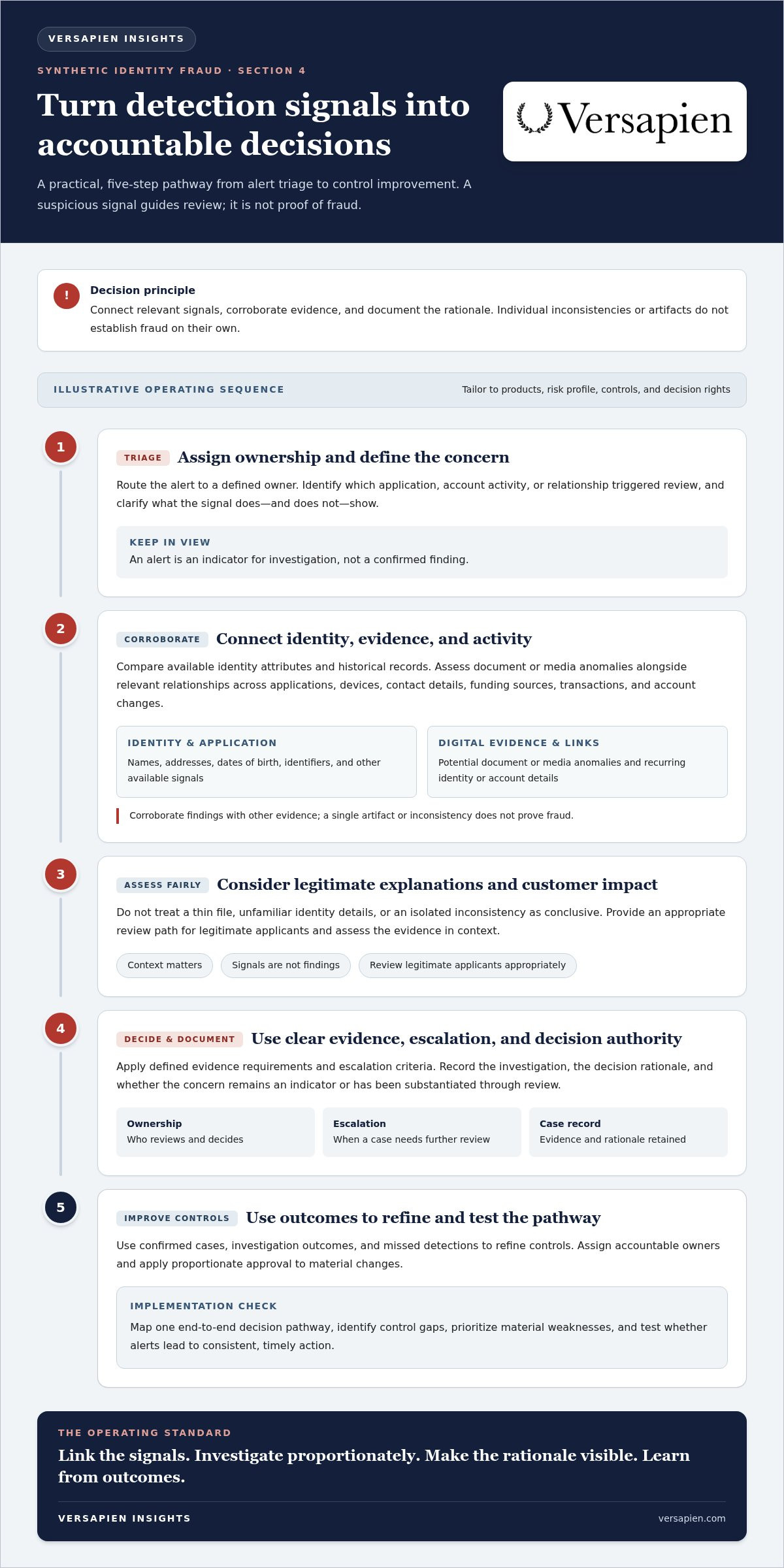
Section 4: Turning Detection Signals Into Accountable Decisions
Alert Triage and Investigation
Organizations should establish clear ownership for alerts, documentation standards, escalation pathways, and decision authorities. Reviewers should record the relevant evidence, reasoning, disposition, and approvals. Risk indicators should be distinguished from verified fraud, with escalation based on defined criteria and proportionate to the potential impact.
Fairness and Customer Impact
Thin files, unfamiliar data, or limited account history should not be treated as conclusive fraud. Legitimate users need a review pathway when automated or initial checks generate concern. Decision records should explain the rationale, evidence considered, and any additional verification or escalation applied.
Feedback and Continuous Improvement
Investigation outcomes, confirmed fraud, legitimate applications, false positives, and missed fraud should inform control updates. Changes should be prioritized against identified gaps and implemented through formal approval, validation, documentation, and post-implementation review processes.
Implementation Priorities
Begin by mapping the decision pathway from initial signal through investigation and final disposition, identifying accountable owners, evidence requirements, escalation criteria, and approval authority. Address material gaps across identity verification, application analysis, linked-identity detection, and lifecycle monitoring. Test whether alerts are resolved promptly and consistently, and use investigation outcomes to prioritize improvements. Priorities should reflect the institution’s products, channels, exposure, and risk appetite.
Executive Takeaways
Use layered detection that combines identity verification, application analysis, document review, and ongoing monitoring.
Apply linked-identity analysis across products, applications, accounts, and channels over the customer lifecycle.
Use evidence-based investigation and distinguish risk indicators from verified fraud.
Provide fair review pathways and document decisions and customer-impact considerations.
Test controls, monitor model performance, and incorporate investigation outcomes into governed improvements.
How Versapien Can Help
Versapien provides advisory services to help organizations evaluate and strengthen their AI governance, fraud detection controls, risk management practices, and regulatory compliance frameworks. Versapien can help assess existing approaches, identify potential gaps, clarify roles and responsibilities, and recommend practical improvements to detection processes and governance practices. Contact Versapien to discuss your organization’s priorities.